Engineering in India for International Students: Colleges, Fees & Careers (2026)
Written by Arun Menon, Specialist in Education Finance | Most recent update: May 27, 2026
Engineering in India for International Students: The Short Answer
Indeed, you can pursue engineering in India without taking the JEE. The Direct Admission of Students Abroad (DASA) initiative and the Study in India (SII) website (studyinindia.gov.in), launched on August 3, 2023, each offer specific quotas for foreign nationals, meaning you’ll not be competing with 1.2 million JEE candidates. Total expenses over four years range from USD 1,000–10,000 (educations.com), which is a small portion of the £62,730 required for a degree at the University of Glasgow (University of Glasgow). Indian central universities generally impose a fee of ₹2–5 lakh annually for engineering (Leap Scholar), while living expenses differ significantly depending on the city (Numbeo):
| City | Budget/month | Comfortable/month |
|---|---|---|
| Pune | ₹12,000 | ₹32,000 |
| Delhi | ₹14,000 | ₹38,000 |
| Bangalore | ₹15,000 | ₹42,000 |
| Mumbai | ₹15,000 | ₹40,000 |
How International Students Get In (Without JEE)
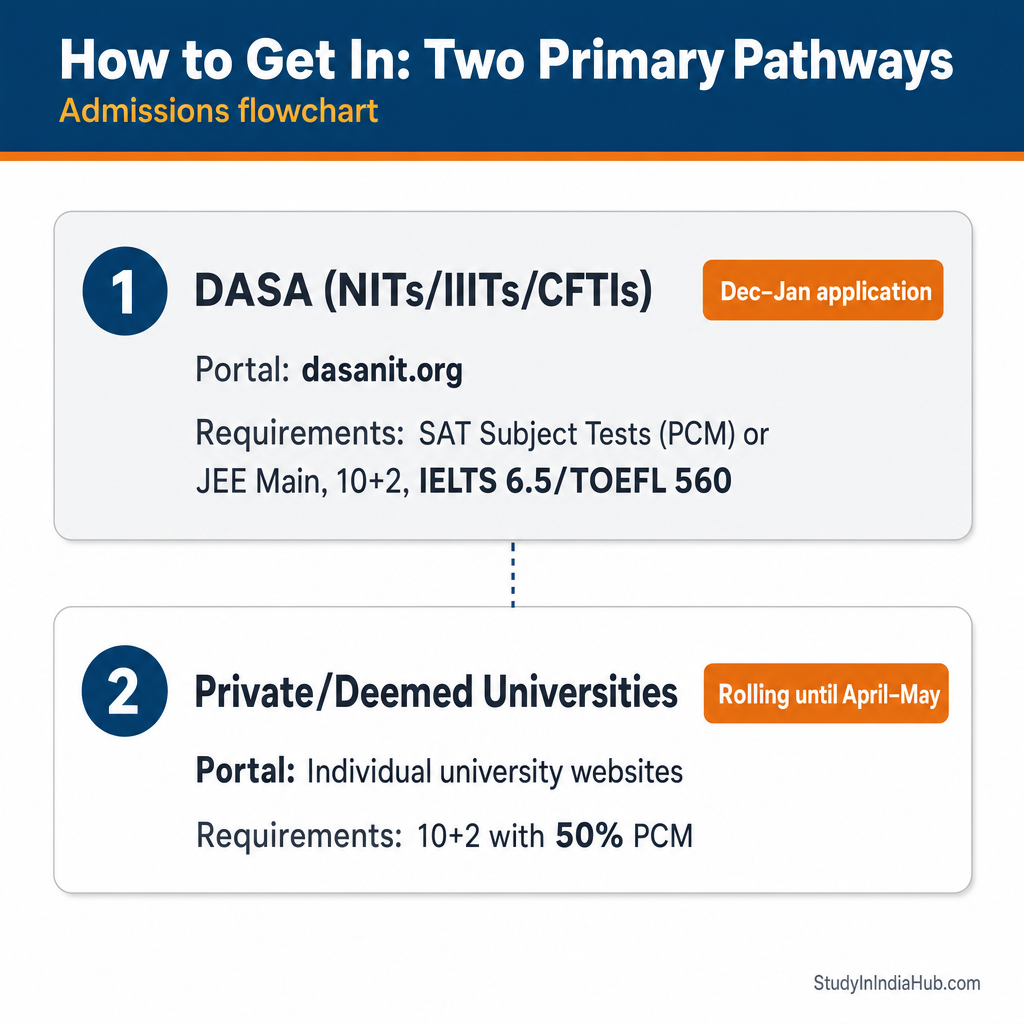
Two primary pathways to enter Indian engineering programs without JEE are the DASA scheme for NITs, IIITs, and other Centrally Funded Technical Institutions, and the Foreign National/NRI quota available in private and deemed universities.
The DASA Route (Government Colleges)
DASA is managed via dasanit.org and welcomes international students, including PIOs and OCIs: using SAT Subject Test results in Physics, Chemistry, and Mathematics Level 2, or JEE (Main) scores for specific categories. Essential qualifications criteria:- Finished 10+2 (12 years of education) with Physics, Chemistry, and Mathematics.- SAT Subject Test scores that are valid and submitted via the DASA portal- English skills: Minimum 6.5 on IELTS Academic or minimum 560 on TOEFL paper-based if previous education was not in English (IELTS, TOEFL)DASA applications generally commence December–January for the July intake of the same year. The complete process, application → counseling → admission: takes 4–6 months. Begin in your last year of secondary school.
The Foreign National/NRI Quota (Private & Deemed Universities)
Private and deemed universities completely skip JEE for international candidates. Applications are submitted directly via the admissions portal of each institution; for instance, Savitribai Phule Pune University has maintained a specialized online portal since 2015–16. Eligibility remains uniform among the majority of institutions:- 10+2 with Physics, Chemistry, and Mathematics, at least 50% overall (40% for specific reserved categories)- Identical English proficiency standards are applicable (edmaster.co)Applications for private universities are ongoing, but deadlines for July intake usually end around April–May. If you miss that opportunity, you'll have to wait an entire year.
Application Strategy
| Feature | DASA Scheme (NITs/IIITs) | Private/Deemed Universities |
|---|---|---|
| Primary Requirement | SAT Subject Scores / JEE Main | 10+2 Marks (min. 50% aggregate) |
| Application Portal | dasanit.org | Individual university portals |
| Typical Tuition | ~USD 4,000/semester | USD 4,000–12,000/year |
| Application Window | December–January | Rolling; closes April–May |
Submit applications to 3–4 colleges through both paths at the same time. One will advance quicker than anticipated, and submitting applications early is the sole method to secure merit scholarship spots that may cover 70–90% of costs.
Top Engineering Colleges for International Students (2026)
The institutions that have the best infrastructure for international students aren't necessarily those that hold the top NIRF rankings. The table below illustrates this reality, emphasizing established international student pathways, clear fee structures, and admission processes that do not necessitate JEE. As per the NIRF 2024 Engineering Rankings, IIT Madras has maintained the #1 spot for nine straight years, with IIT Delhi at #2 and IIT Bombay at #3, while IISc Bangalore and IIT Kanpur complete the top five. The NIRF 2025 rankings, anticipated in August 2025, will utilize the identical five-pillar framework: Teaching & Learning Resources, Research, Graduation Outcomes, Outreach & Inclusivity, and Peer Perception. International students can verify these scores on the official nirfindia.org website prior to completing applications.
| College | City | Admission Route | NIRF Rank (Eng) | Annual Tuition |
|---|---|---|---|---|
| IIT Bombay | Mumbai | DASA / Direct Foreign Category | 1–3 | USD 10,000–15,000 |
| IIT Delhi | Delhi | DASA | 1–5 | USD 10,000–15,000 |
| IIT Madras | Chennai | DASA | 1–5 | USD 10,000–15,000 |
| NIT Trichy | Tiruchirappalli | DASA | 9–12 | USD 4,000–6,000 |
| NIT Surathkal | Mangalore | DASA | 10–15 | USD 4,000–6,000 |
| BITS Pilani | Pilani / Goa | BITSAT (International) / Direct | 11 | USD 20,000–25,000 |
| VIT Vellore | Vellore | Direct | 18 | USD 12,000–16,000 |
| Thapar Institute | Patiala | Direct / Merit | 20–30 | USD 8,000–12,000 |
| COEP Technological University | Pune | DASA / CIWGC | 70–80 | USD 4,000–6,000 |
| VJTI | Mumbai | DASA / CIWGC | 80–100 | USD 4,000–6,000 |
| SPPU Affiliated Colleges | Pune | SPPU International Centre | 40–80 | ₹1.25–1.67 lakh |
| MIT-WPU | Pune | Direct / Entrance | 100–150 | ₹4–7 lakh |
All amounts listed are for tuition fees only. Include accommodation costs and living expenses individually. The annual living expenses in Mumbai and Pune presently range from USD 15,000 to 25,000 for a comprehensive overview (BrainGainMag).
Three things this table doesn't show that matter
DASA includes both IITs and NITs, utilizing the same portal, the same application period, with no requirement for JEE. NITs located in Category B cities (Gandhinagar, Jaipur, Lucknow, Bhopal, Chandigarh) provide tuition fee reductions of up to 24% on the tuition portion, potentially lowering NIT expenses to under the USD 4,000 threshold (DASA).SPPU is the biggest center for international students in India, with around 14,000 international students from over 102 countries: this indicates that visa processing, FRRO registration, and support on campus are truly institutionalized rather than being improvised (Study in India).Students from SAARC nations often meet the criteria for reduced fee categories at Central Universities, which can be as minimal as ₹2,00,000 annually (CU Himachal). In 2022, 13,126 students from Nepal were enrolled in India, indicating a genuine demand as shown by these statistics (IndoGlobal).
What Engineering Will Cost You: Fees Compared
The figure on the website is never the ultimate figure. The overall expenditure for a 4-year B. Tech program is influenced by the college's tier, location, and various additional costs, including hostel, mess, registration, and exam fees, which may contribute US$1,500–US$3,000 annually in addition to tuition (Study in India Portal; indiainatlanta.gov.in).
Fee Breakdown by College Tier
| Cost Component | Tier 1: IIT/NIT via DASA | Tier 2: Top Private Deemed | Tier 3: Mid-Tier Private |
|---|---|---|---|
| Annual Tuition | ₹2–5 lakh | ₹3–15 lakh | ₹1.5–4 lakh |
| Annual Hostel & Mess | ₹40,000–₹2,50,000 | ₹1,42,000–₹1,84,000 | ₹30,000–₹1,20,000 |
| 4-Year Total (Tuition + Hostel) | ₹9.6L–₹30L (~US$11,500–36,000) | ₹13.6L–₹70L (~US$16,300–84,000) | ₹7.2L–₹20.8L (~US$8,600–25,000) |
Illustrations to ground these figures: BITS Pilani demands ₹36,000 each semester for accommodation; a triple-sharing room at Chanakya University costs ₹1,42,000 yearly (Chanakya University). Check the existing fee notification for any institution prior to making a commitment.
City Living Costs
Choosing a city impacts your overall experience more than many brochures acknowledge:- Mumbai, intense demand for housing and food; off-campus rent may surpass ₹15,000/month.- Pune, slightly lower; a hostel on campus in the ₹1,000–₹3,000/month range is achievable.- Lesser towns, managing monthly expenses is simpler, especially where college dormitories are at the lower spectrum of the yearly range.
India vs. Other Study Destinations
Higher education in India is offered at approximately one-fourth the price of similar programs in numerous Western nations (indiainatlanta.gov.in). A semester in India may cost around NPR 2–3 lakh, compared to NPR 10–15 lakh for a semester in the US (indoglobal.com.np).
Which Engineering Branch Should You Choose?
CS/IT consistently provides the best placement results and initial salaries. Chennai Institute of Technology announces a 95.8% placement rate (Chennai Institute of Technology), and this trend is consistent among both mid-tier and top institutions. At IIT Bombay, the B. Tech CSE program achieved a 92% placement rate, with an average CTC of ₹30 LPA, a median of ₹28 LPA, and a top package of ₹1.5 crore (Shiksha), significantly surpassing the overall B. Tech placement rate of 81.79% (678 out of 829 placed) in 2025 (IIT Bombay Placements). All industries: technology, finance, startups. employ CS graduates, establishing it as the least risky field if you're unclear about your career path.
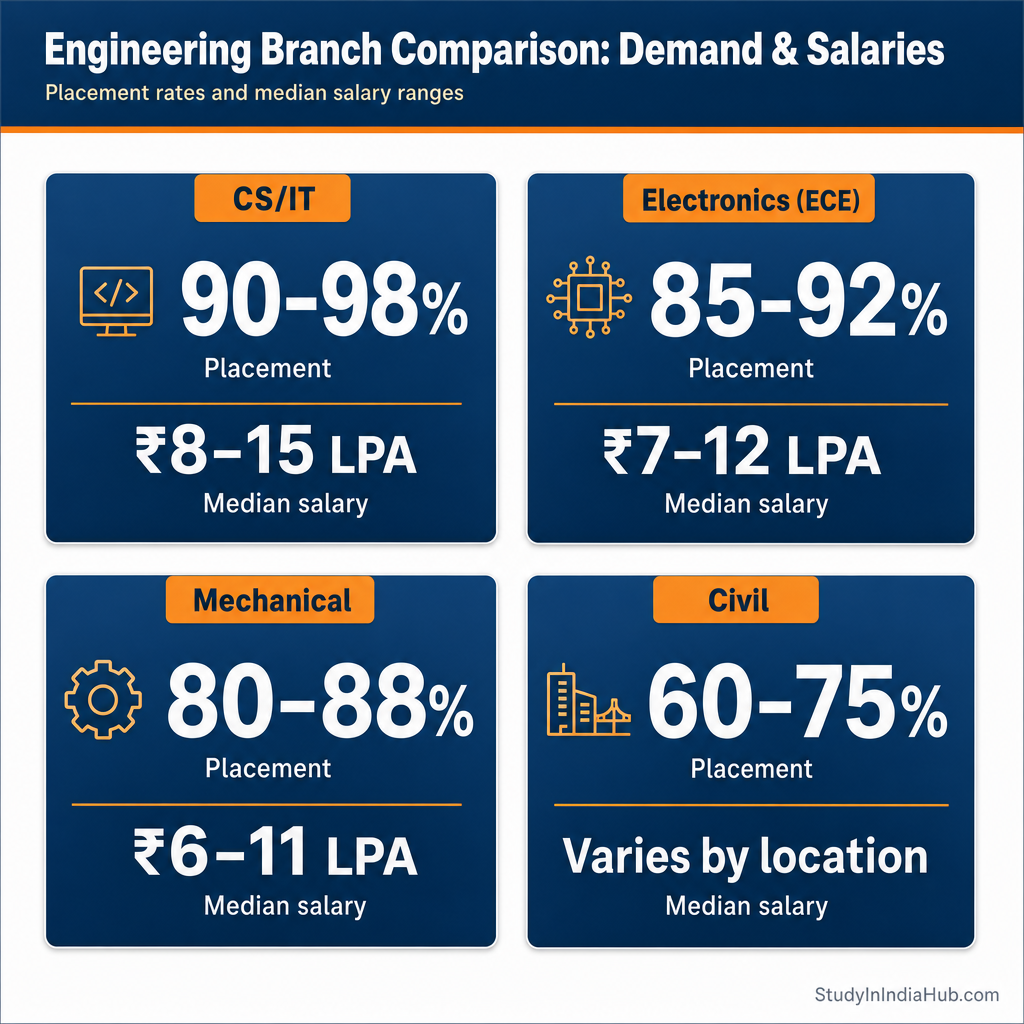
| Branch | Industry Demand | Typical Placement Rate | Median Package (Mid-Tier) |
|---|---|---|---|
| CS / IT | Very High | 90–98% | ₹8–15 lakh/year |
| Electronics (ECE) | High | 85–92% | ₹7–12 lakh/year |
| Mechanical | Moderate | 80–88% | ₹6–11 lakh/year |
| Civil | Moderate | 60–75% | Varies by location |
Electronics and Communication (ECE) offers great versatility, strong job placements, and the flexibility to switch between hardware and software positions. Mechanical engineering covers the widest range of industries (automotive, manufacturing, aerospace) but faces greater competition. Civil engineering job opportunities are largely influenced by the college's location; urban campuses near ongoing infrastructure projects excel compared to others.A remark on the variability of placement rates: Even top-tier schools are susceptible to fluctuations in hiring trends. IIT Bombay's total placement rate decreased from nearly 90% in 2022–23 (IIT Bombay Placement Report 2022-23) to around 75% in 2023–24 (IIT Bombay Placement Report 2023-24), and declined further to 70% in 2025 (Shiksha). Average and median packages remained stable at ₹26.45 LPA and ₹20 LPA respectively in 2024–25; however, the proportion of students securing placements has decreased. Exercise caution with any individual-year placement figures and examine 3-year trends when feasible.Important limitation to confirm prior to applying: Certain colleges impose restrictions on branch choices within the foreign national quota. For instance, Terna Engineering College provides no Mechanical seats for international students but has 18 seats for Computer Engineering. Review the prospectus of each college under "Foreign National Seats"; this information is often not readily available on many websites. Tuition costs are generally comparable across disciplines, ₹8–20 lakh in total for 4 years (Retirewise): thus, selecting a branch is a career choice rather than a financial one. Changing branches during a course is uncommon in Indian universities; make your choice before applying.
Career Prospects and Placements After Graduating in India
International students completing their studies in India do not benefit from an automatic post-study work period. To stay and work, you must change your S-1 Student Visa to an Employment Visa with the help of a sponsoring employer, and the existing minimum salary requirement is ₹16.25 lakhs per annum (around USD $25,000), established in the MHA notification on 1 April 2017 and still applicable as the standard for 2026 recruitment (MHA; Ministry of Home Affairs via india-guide.in). New graduates with offers below that limit cannot obtain visa approval and are required to go back to their home country or relocate to a third country. A student we guided from Kathmandu submitted her application to VIT Vellore in November 2021, got her offer by April 2022, and finished her B. Tech in CSE by June 2026. Her total expenditure over four years amounted to about ₹14.8 lakh for tuition and roughly ₹4.2 lakh for hostel and living expenses, and she secured a position with a Bangalore-based product company at ₹11.5 LPA during campus placements. Regarding the work transition, her employer started the Employment Visa conversion via FRRO Bengaluru approximately six weeks prior to her course completion date, a schedule we suggest other international students prepare for ahead of time.
| Country | Post-Study Work Option | Key Requirement |
|---|---|---|
| India | Convert to Employment Visa | Job offer ≥ ₹16.25 LPA / USD $25,000 |
| Germany | 18-month job-seeker visa (Make it in Germany) | Secure a degree-relevant role |
Placement Data at Top Institutions
At the IIMs and ISB, placement rates within three months post-graduation often approach 100% (Study in India). Top IITs and NITs show similarly strong campus recruitment figures, with firms such as TCS, Infosys, L&T, and Goldman Sachs recruiting directly via placement events. Detailed placement statistics for international graduates are not made available separately, so confirm recruiter lists directly with the placement office of each institution.
Why Mumbai and Pune Matter
Both cities are located within concentrated IT, manufacturing, and finance employer hubs. This implies that campus recruitment is enhanced by visits to local companies, internships, and referrals from alumni, all of which are significant in securing an offer that meets the MHA's ₹16.25 LPA visa requirement. A college with lower fees and fewer recruiters may ultimately be more expensive than one with higher fees and established national recruiters.
International Value of the Degree
Indian engineering degrees are offered through English-medium instruction and involvement with extensive technical systems. IIT and NIT qualifications are recognized worldwide in technology and production. For students going back home or aiming for a third country, the degree's accreditation and the university's alumni network serve as the practical criteria for mobility, rather than just the tuition cost.
Scholarships and Financial Aid for International Students
The ICCR A2A Scholarship Programme serves as India's main financial pathway for international students, offering a complete tuition waiver along with a monthly living stipend of ₹10,000 (UG), ₹12,000 (PG), or ₹14,000 (PhD), distributed via PFMS since February 2021 (ICCR Policy Guidelines). The application period for 2026–27 occurred from 27 February to 15 April 2026, with a minor extension reported in certain channels until 22 April (CGI Chicago). Miss that deadline and you wait an entire year: there is no late submission option. ICCR processes tens of thousands of applications each year for its general scholarship programs, with engineering continually being one of the most competitive fields. During the 2026–27 cycle, engineering placement acceptance rates are approximately 5%. Consider ICCR as an alternative in a wider funding approach, rather than the main source.Competition is intense. For 2026–27, about 4,000 Sri Lankan students sought around 200 fully funded positions (Jaffna Monitor). Distinct designated programs have restricted availability:
| Scheme | Slots |
|---|---|
| Atal Bihari Vajpayee General Scholarship | 630 (IndEmb Kathmandu) |
| Sushma Swaraj Silver Jubilee Scholarship | 100 (IndEmb Kathmandu) |
Even a successful ICCR award seldom covers all expenses; hostel and mess fees are excluded, so plan for the difference. Certain institutions provide fee discounts for SAARC category; for instance, the Central University of Himachal Pradesh features a ₹2,000 SAARC fee option.
Practical Checklist Before You Apply
Apply for your **Student (X)
Common Mistakes to Avoid
Ignoring the security deposit. Numerous universities require a refundable security deposit ranging from ₹25,000 to ₹50,000, in addition to your tuition and accommodation costs. Plan for it in advance to avoid rushing when the admission offer arrives. You'll receive it back upon graduation, but you require the money from day one.Assuming hostel accommodations are assured. Availability of hostel spaces is restricted, and not all institutions grant international students automatic priority. Once your admission is confirmed, delaying even two weeks can put you on a waitlist or compel you to seek more expensive private postgraduate housing. Always keep a contingency plan ready in case the hostel application fails.Misjudging expenses in cities apart from Mumbai and Pune. Students frequently believe that smaller towns such as Vellore, Manipal, or Bhubaneswar will be very inexpensive, but costs can accumulate quickly when considering transport, dining out, and traveling to a major airport. Budget for ₹15,000-₹20,000 monthly for living costs, even in tier-2 cities. Currency variations can also sting, so create a cushion.Failing to apply for scholarships prior to the deadline. Deadlines for scholarships aimed at international students typically end several months before the academic year begins, and numerous students overlook them due to their focus on admissions. Review ICCR, college-specific waivers, and bilateral programs from your home country immediately after initiating your application. Late submissions are seldom accepted, regardless of how impressive your profile may be.
Frequently Asked Questions
Do the universities in Mumbai and Pune have the same fees for international students?No. BTech at Mumbai University costs ₹60,000–₹7,70,000 annually, while SPPU in Pune offers the same degree for ₹40,000–₹1,80,000 each year (Shiksha/Mumbai University, Shiksha/SPPU). Two institutions may have a common city designation yet exist at different extremes of that spectrum; always ask for the current international fee schedule for your particular intake year.What if I transition to an MBA rather than pursuing engineering?The fee range changes completely. Mumbai University MBA costs ₹42,600–₹8,40,000 annually; SPPU MBA is priced at ₹50,000–₹2,50,000 per year. Allocate funds for your backup plan independently, as changing fields during your journey entails an entirely different expense framework.
Can I work part-time to offset living costs?
Your student visa allows a maximum of 20 hours each week during academic periods. On-campus employment and nearby tutoring usually offer ₹150–₹300/hour, resulting in approximately ₹12,000–₹24,000/month, sufficient for groceries and transportation, but not for tuition or housing. My scholarship pays for tuition. Which funds must I still display?You are required to show available liquid funds for living expenses and a return flight, irrespective of your scholarship status. India's FRRO requires a bank statement that demonstrates your complete living expenses for the first year in Pune, with an estimated budget of at least ₹10–12 lakhs** in readily available savings. A sanctioned loan letter that outlines the disbursement schedule is accepted; a standard eligibility letter is not.
What's the biggest hidden cost students miss?
A 15–20% cushion on your overall projected budget (immitalks.com). One unplanned hospitalization or flight back home can cost ₹25,000+. University health insurance generally ranges from ₹5,000–₹10,000/year; if the coverage is less than ₹3–5 lakhs, consider adding a private top-up plan.What occurs if I arrive in Delhi but attend school in Pune?You are required to register with the FRRO in your university town within 14 days of arriving, no matter which entry point you used. Failing to meet that deadline results in penalties and possible visa issues.
Are seats at affiliated colleges fixed for foreign nationals?
Seat assignment differs by institution. At Terna Engineering College (affiliated with Mumbai University), there are seats for foreign nationals, PIO, OCI, and NRI wards in: Computer Engineering, 18 seats, Electronics & Telecommunication: 12 seats, Mechatronics. 6 seats, and none available under Mechanical Engineering**. Admissions are conducted according to AICTE guidelines and are managed directly by the college's Admission Cell.
About the Author
Arun Menon dedicated three years at ICCR overseeing scholarship initiatives before moving to StudyInIndiaHub.com to assist international students in understanding tuition fees, living expenses, and financial support alternatives. He simplifies intricate fee structures into straightforward comparisons and is aware of the specific costs that universities fail to disclose initially.
How We Researched This Article
Every article is verified against original sources and evaluated by education experts with firsthand experience in international student admissions. Our information is sourced from official university websites, NAAC/NIRF databases, governmental visa portals, Numbeo cost-of-living statistics, and direct interactions with university international student offices. Daily updates for exchange rates. Living expenses updated weekly. University information assessed every three months. Based on our experience with international applicants, the size of the current foreign group is more significant than brochures indicate. When a university handles thousands of FRRO registrations, visa renewals, and bonafide letters annually, like SPPU with its 14,000 international students, the international office typically has specialized personnel, standardized documentation, and quicker processing times. Smaller cohorts frequently result in students managing hostel assignments, police registration, and SIM card paperwork independently, which can detract from the first semester.
Sources
- studyinindia.gov.in
- educations.com
- University of Glasgow
- Leap Scholar
- Numbeo
- dasanit.org
- IELTS
- TOEFL
- Savitribai Phule Pune University has run a dedicated online portal since 2015–16
- edmaster.co
- SPPU International Centre
- BrainGainMag
- CU Himachal
- IndoGlobal
- Study in India Portal
- indiainatlanta.gov.in
- Chanakya University
- indoglobal.com.np
- Chennai Institute of Technology
- Shiksha
- IIT Bombay Placements
- IIT Bombay Placement Report 2022-23
- IIT Bombay Placement Report 2023-24
- Retirewise
- MHA
- Ministry of Home Affairs via india-guide.in
- Make it in Germany
- ICCR Policy Guidelines
- CGI Chicago
- Jaffna Monitor
- IndEmb Kathmandu
- University of Hyderabad
- Indian Visa Online
- Embassy of India, Vilnius
- Shiksha/Mumbai University
- Shiksha/SPPU
- immitalks.com