MBBS in India for International Students: Fees, Eligibility, Top Colleges (2026)
By Arun Menon, Specialist in Education Finance | Most recent update: May 27, 2026Pursuing MBBS in India is among the least expensive medical options available for international students. This manual outlines tuition costs, eligibility criteria, NEET-UG standards, leading institutions, scholarships, and the visa procedure for the 2026 admissions. Contrasting India with the UK, Canada, or Australia? The difference in cost is significant. However, the regulations are specific. Examine thoroughly before submitting your application.
[IMAGE PLACEHOLDER: Hero image — international students in white coats at an Indian medical college campus]
MBBS in India for International Students: Key Facts at a Glance
| Feature | Details |
|---|---|
| Duration | 5.5 years (4.5 academic + 1-year internship) |
| Mandatory Exam | NEET-UG (Study in India Portal) |
| Total Cost | About one-fourth of Western options (indiainatlanta.gov.in) |
| Recognition | WDOMS-listed; accepted in Nepal, Sri Lanka, UAE — check your home country first |
| Application Gateway | Study in India (SII) Portal, launched 3 August 2023 |
Clinical training is integrated throughout the entire course. This degree isn't solely focused on the classroom. The internship for one year is mandatory. You rotate through various departments prior to receiving your final certificate.Scholarship opportunities: ICCR has revealed 640 international scholarship slots for 2025–26 (indembsofia.gov.in). Students hailing from Nepal, Bangladesh, and Sri Lanka might be eligible for fee concessions under the SAARC quota at various central universities (Study in India Portal).Cost warning: Consider any charge on a college site as a baseline. Not a conclusive bill.
What MBBS in India Actually Costs for Foreign Students
[IMAGE PLACEHOLDER: Cost comparison infographic — India vs UK/USA/Australia/Canada MBBS fees]
| College Type | Annual Tuition (USD) | 5.5-Year Total (USD) | Key Cost Driver |
|---|---|---|---|
| Government (All India / Foreign Seats) | $15,000–$30,000 | $82,500–$165,000 | Seat category and university fee policy (Study in India) |
| Premier Government (AIIMS-tier) | $50,000+ | $275,000+ | Institutional pricing varies (Study in India) |
| Private (Management / NRI Quota) | $20,000–$60,000 | $110,000–$330,000 | Quota pricing, brand, extra charges (DASA portal) |
The figure displayed on the website is not the ultimate figure. The distinction between government and private lies in the seat quota framework. Government colleges allocate approximately 15% of seats under the All India Quota for foreign nationals, NRIs, and OCIs. Certain individuals are accepted via pathways such as DASA. Private colleges offer a greater number of management quota seats to international students, and they require a fee for these. A foreign-national spot at a public college priced at $15,000–$30,000 annually can be significantly less expensive than a high-end private institution costing $25,000–$60,000 each year in the same city. One aspect students frequently overlook: "government seat" doesn't necessarily imply "reduced fee." The ultimate sum relies on three factors:- The fee circular from the college itself- The label indicating your quota on the acceptance letter- The hostel classification in your assignmentObtain all three in written form prior to making any payment. Quota regulations change annually. JIPMER has eliminated its NRI quota seats (indiatointernational.com). Previous guides that reference those seats are no longer current. Always verify the current quota situation with the college prior to submitting your application.
Hostel and Living Costs
Tuition represents just a portion of the overall situation. International students pay ₹40,000–₹2,50,000 annually for on-campus hostel and mess fees (Chanakya University). Shared housing and food off-campus typically range from ₹10,000 to ₹20,000 monthly in many university towns. A practical monthly budget, which includes a Jio SIM for ₹499 over 28 days (Study in India), totals ₹25,000–₹35,000.
[IMAGE PLACEHOLDER: Student hostel room and mess hall — typical on-campus accommodation]
True 5.5-Year Budget
- Public tuition: $82,500–$165,000- Hostel (5.5 years): ₹2,20,000–₹16,50,000 (~$2,600–$19,500)- Cost of living: ~$3,000–$5,000 annually (~$16,500–$27,500 overall)- Overall, public university: ~$101,600–$212,000- Overall, private university: ~$130,000–$322,000Consistently include a 15–20% cushion for unexpected travel, medical, and miscellaneous expenses (immitalks.com).
How India Compares to Other Study Destinations
Even at the highest level, India’s MBBS expenses are approximately a quarter of similar Western programs (indiainatlanta.gov.in).
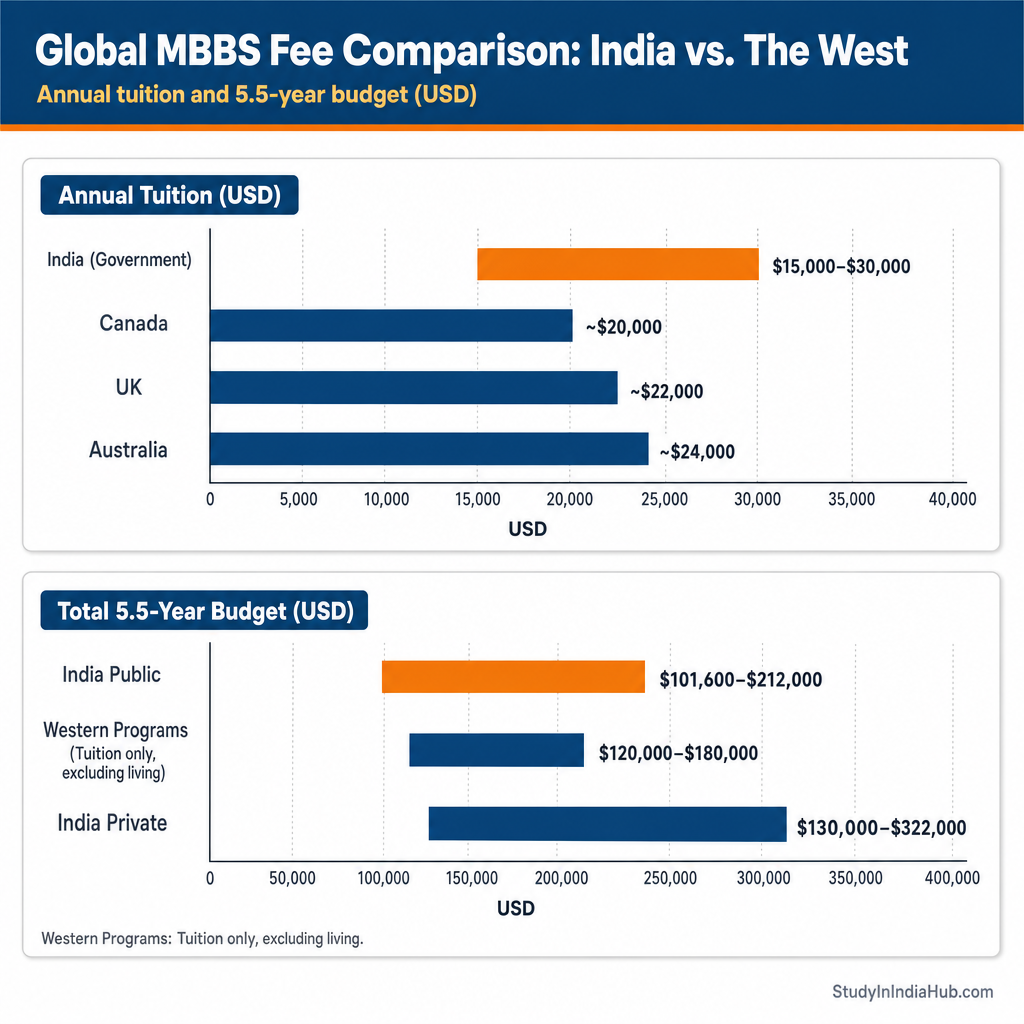
| Country | Approx. Annual Medical Tuition (USD) | Source |
|---|---|---|
| India (Government) | $15,000–$30,000 | Study in India |
| Canada | ~$20,000 | Statistics Canada |
| UK | ~$22,000 | UCAS |
| Australia | ~$24,000 | Study Australia |
During a 5–6 year duration, those Western programs cost between $120,000 and $180,000, not including living expenses. ICCR and Study in India scholarships can reduce costs for students from Nepal, Bangladesh, Sri Lanka, UAE, Kuwait, and many parts of Africa and the Middle East (ICCR Policy Guidelines). Prior to your decision, contact the college's international student office via email. Request the precise fee letter for the 2026–27 cycle. Released PDFs become outdated. A signed fee agreement does not.
Eligibility and NEET Requirements for International Applicants
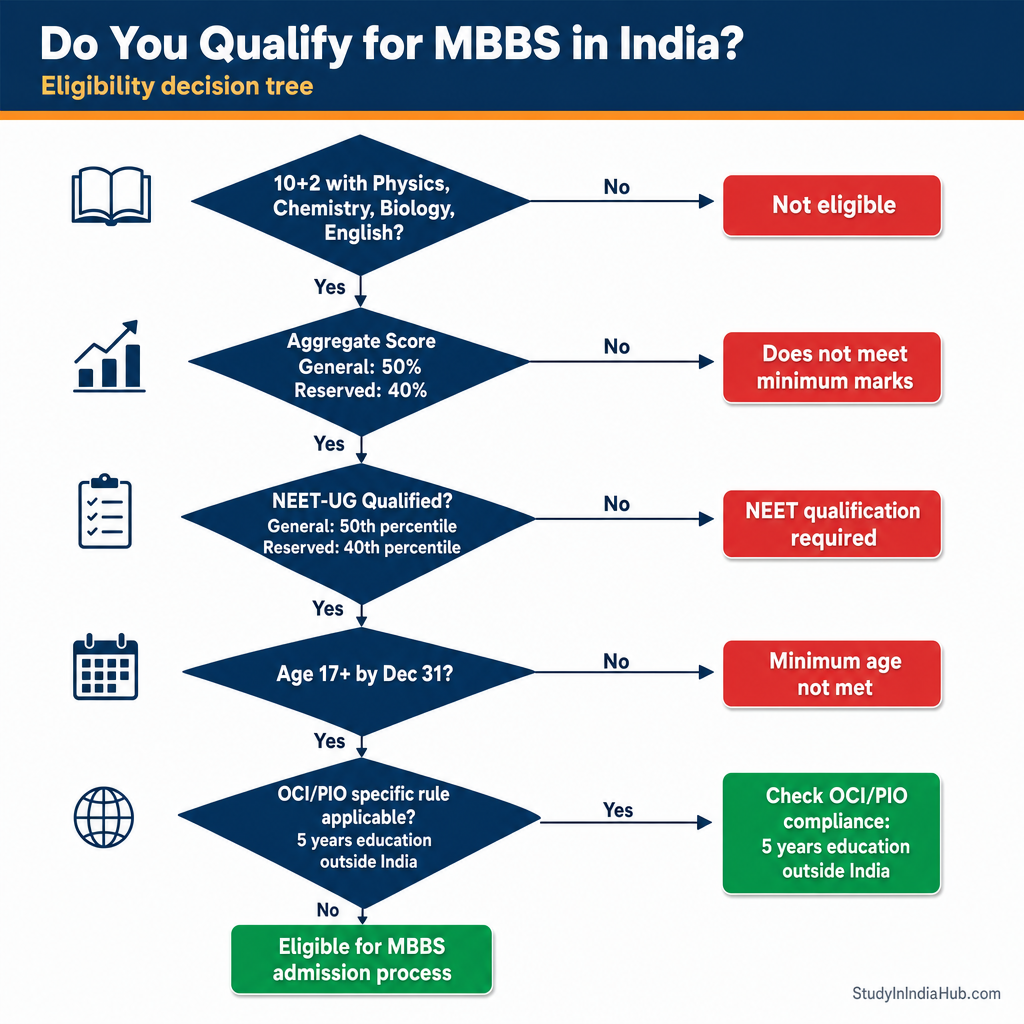
A minimum overall score of 50% in Physics, Chemistry, and Biology/Biotechnology in Class XII or its equivalent is required. Reserved categories (SC/ST/OBC schemes) might require 40%. Verify each university personally. Regulatory frameworks at both state and institutional levels differ (ICCR Policy Guidelines).
NEET-UG: Who Must Sit, Who Is Not Exempt
All international candidates, NRI, OCI, and PIO applicants are required to take and successfully complete NEET-UG to seek admission to MBBS in India. There isn't a universal international exemption. Cut-off points change annually, but generally function in this manner:
| Category | PCB Aggregate | NEET-UG Qualifying Percentile |
|---|---|---|
| General (Foreign / OCI / NRI) | 50% | 50th |
| Reserved (SC/ST/OBC schemes) | 40% | 40th |
A prevalent misconception: OCI status means rules for Indian applicants. It does not. OCI and PIO applicants need to have completed their education through Class XII outside of India. They also must not have attended the Indian education system for the 5 academic years prior to applying (ICCR Policy Guidelines).
Seats and Age
Foreign-national seats are additional, included beyond the usual intake. They are limited to 15% of authorized seats for each course. You aren't vying with local candidates. However, seats remain limited. The NEET score is the most important factor. At AIIMS New Delhi, the seats for foreign nationals are quite scarce. You will require excellent academic performance and a high NEET score. The minimum age is 17 years as of 31 December of the year of admission. No variations. Before submitting your application, obtain the official admission notice from the college you are aiming for. Additionally, obtain the latest NEET bulletin. Internal cut-offs may surpass the national minimums.
How to Apply: Admission Process and Timeline
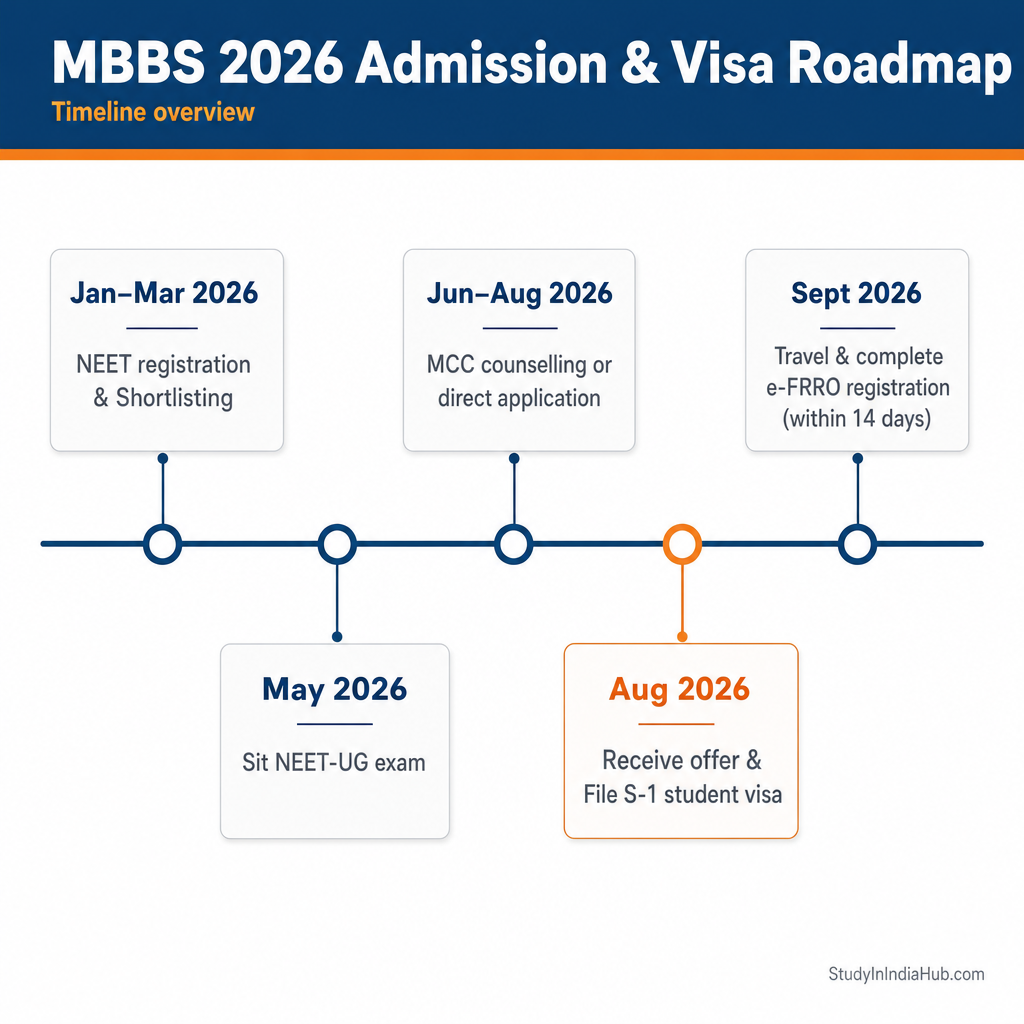
The entire process takes 8–10 months from NEET registration to admission. Fail to meet a deadline and you risk losing the entire 2026 cohort.
[IMAGE PLACEHOLDER: Application timeline flowchart — NEET → Counselling → Visa → FRRO]
Licensing Exams You'll Also Pay For
If you intend to practice overseas following your MBBS, consider the costs of licensing exam fees:
| Exam | Country | Approximate Cost |
|---|---|---|
| USMLE Step 1 / Step 2 CK | USA | USD 1,300 each |
| PLAB Part 1 | UK | GBP 264 |
| PLAB Part 2 | UK | GBP 945 |
| ERPM (SLMC exam) | Sri Lanka | LKR 30,000 per attempt |
| FMGE / NExT | India (for foreign citizens) | Variable |
Indian graduates must pass the FMGE/NExT prior to practicing in India. Numerous international students overlook this when arranging their journey back home.
Step-by-Step Process
Step 1, NEET-UG Registration and Exam (Jan–May 2026)
Sign up on the NTA platform at the beginning of 2026. The test is typically conducted in May. No distinct global entry examination exists. Foreigners take the same NEET as Indian students (Study in India).
Step 2, Counselling or Direct Application (June–August 2026)
After results, the path splits by seat type:
- Government seats: Distributed via MCC (Medical Counselling Committee) counseling, prioritized by NEET score.- Private seats: Submit your application directly to the college. CMC Vellore manages its own selection process and might interview you within 2–3 weeks.- Medical/paramedical courses: A No Objection Certificate from your home country's Ministry of Health is also required (Study in India).
Step 3, Admission Offer and Visa Filing (August 2026)
The application for an S-1 student visa commences only once you receive a formal offer letter. Indian missions require a minimum of 3 business days. Actual timelines vary 2–8 weeks depending on the country and season. The High Commission of India in Colombo does not provide a specific average processing time for S-1 student visas (Indian Visa Online). Applicants from Sri Lanka need to submit their applications promptly. Required documents include: admission letter, academic transcripts, and financial proof (Qogent visa guidance).
Step 4, Arrival and FRRO Registration (Within 14 Days)
Enroll with the FRRO via the Study in India Portal within 14 days of arrival. The FRRO authority processes the Registration Permit (RP/RC) (Study in India). Overlook this and you'll incur a penalty of around USD 30. Submit your application at least 2 weeks in advance.
2026 Intake Timeline
| Month | Action |
|---|---|
| Jan–Mar 2026 | NEET registration; gather academic records; shortlist colleges |
| May 2026 | Sit NEET-UG exam |
| Jun–Aug 2026 | MCC counselling or direct application; receive offer |
| Aug 2026 | File S-1 student visa right after offer letter |
| Sept 2026 | Travel; complete e-FRRO registration within 14 days |
Top Medical Colleges in India for International Students
Every college listed by the NMC is also included in the WHO directory of medical schools (NIRF 2024). That serves as the standard for licensing in Nepal, Sri Lanka, and the majority of Gulf states. Acknowledgment outside of India relies on the medical council of your home country. Confirm that independently.
[IMAGE PLACEHOLDER: Map of India highlighting top medical colleges by city]
In 2026, several myths frequently arise on forums such as r/MBBS:- JIPMER and AIIMS do not accept international students through distinct quotas. Instead, consider applying through counselling based on NEET or to private deemed universities. SAARC students do not receive fee reductions at AFMC. AFMC is not open to non-citizens.- NEET is still needed for NRI seats at KMC Manipal. NMC mandates it for every MBBS admission in India.
| College | City | Type | Annual Fee (Approx.) |
|---|---|---|---|
| JIPMER | Puducherry | Central government | ₹50,000–₹1,00,000 (limited foreign seats) |
| Maulana Azad Medical College | Delhi | State government | ₹50,000–₹1,00,000 |
| Grant Government Medical College | Mumbai | State government | ₹50,000–₹1,00,000 |
| IMS, BHU | Varanasi | Central university | ₹50,000–₹1,00,000 |
| CMC Vellore | Vellore | Private/aided | ₹50,000–₹1,00,000 |
| KMC Manipal | Manipal | Private/deemed | ₹18,00,000–₹22,00,000 |
| Dr. D. Y. Patil Medical College | Pune | Private/deemed | ₹20,00,000–₹25,00,000 |
| Sri Ramachandra Institute | Chennai | Private/deemed | ₹20,00,000–₹25,00,000 |
| M. S. Ramaiah Medical College | Bengaluru | Private/deemed | ₹25,00,000–₹35,00,000 |
| Hamdard Institute | New Delhi | Private/deemed | ₹15,00,000–₹20,00,000 |
| SRM Medical College | Chennai | Private/deemed | ₹20,00,000–₹28,00,000 |
| Symbiosis Medical College for Women | Pune | Private | ₹18,00,000–₹25,00,000 |
All mentioned colleges are recognized by NMC/WHO. Always check fees directly on university websites before making any payments. Annual updates are typical. Numbers from third parties are not mandatory (Study in India).
Which Colleges Draw Which Student Populations
Nepal and Sri Lanka: Government institutions (JIPMER, Maulana Azad, BHU-IMS) take precedence. Charges are a part of privately available options. KMC Manipal is the leading private selection. The reason it shows up on almost every shortlist is its South Asian alumni network (NIRF Engineering 2024). CMC Vellore is excellent for applicants from Sri Lanka, although it is highly competitive.Gulf (UAE, Kuwait, Saudi Arabia): Students from Kuwait and UAE are eligible to apply for the Study in India Scholarship. This can significantly alter the actual fee. Verify eligibility prior to evaluating sticker prices (ICCR Policy Guidelines). KMC Manipal and D. Y. Patil Pune are the most popular private choices. Gulf regulatory authorities (UAE Ministry of Health, Saudi Commission for Health Specialties) conduct their own evaluations. An NMC listing is beneficial, yet it may not suffice. The DASA program serves as the primary application portal for SAARC and international students aiming for institutional placements.
Is an Indian MBBS Degree Recognized Internationally?
Indeed, if the institution is listed in the World Directory of Medical Schools (WDOMS) and recognized by the National Medical Commission (NMC). However, that baseline does not grant you immediate practice privileges anywhere. Each nation implements its unique licensing framework. The most frequent error observed is mixing up NMC recognition with an authorization to practice overseas. NMC endorsement indicates the institution complies with Indian standards. Each nation has its unique licensing process:- USA: United States Medical Licensing Examination- UK: PLAB- Australia: AMC- India (non-citizens): FMGEStudents who schedule their licensing exams while in MBBS, rather than afterwards, transition into clinical practice with much greater ease.
| Country | Entry Qualification Recognized | Requirement to Practice |
|---|---|---|
| Nepal | NEB +2 = Indian Class 12 | Pass Nepal Medical Council exam; register before practice |
| Sri Lanka | GCE A/L (3 subjects) = Indian Class 12 | Pass SLMC Professional Exam or get provisional registration |
| UAE | UAE Secondary (CBSE/IB direct; other boards need AIU equivalency) | Dataflow verification + DHA/MOH exam |
| Kuwait | Thanawiya Amma (with AIU equivalency) | Local licensing exam |
| Bangladesh | HSC = Indian 12th | Local licensing exam |
| UK | Indian MBBS recognized | PLAB exam (mandatory) |
| USA/Canada | Indian MBBS recognized | USMLE Steps 1–3 / MCCQE (mandatory) |
Source: Study in India
Three country-specific details to handle before you enroll:
- Nepal: Ensure you register with the Nepal Medical Council prior to commencing your MBBS to safeguard future eligibility. The process from graduation to registration typically requires 3–6 months following your return.- Sri Lanka: Ensure your Indian college is recognized by the SLMC. NMC endorsement by itself is insufficient. Students who chose NMC-approved private colleges that are not recognized by SLMC have forfeited their right to practice in their home country.- UAE: Graduates not from CBSE/IB require an AIU equivalency certificate. This may require as long as 11 days and needs to be completed prior to admission. The fees for the USMLE exam alone range from USD 1,000 to 1,500, not including study time. Always verify the current status of recognition on the NMC portal prior to paying any seat-booking fee. Catalogs evolve. Making the wrong decision may lead to additional tests or even the absence of a license.
Scholarships and Fee Waivers Available to Foreign Students
There are no known instances of a full scholarship that covers all MBBS expenses for an international student in India. Full-ride medical scholarships are quite scarce due to the high demand for seats. The truthful response: partial financing is feasible. Complete coverage is absent. The "100% scholarship" tag in many search results is deceptive.
[IMAGE PLACEHOLDER: Scholarship application checklist infographic]
In one instance we addressed, a student from Nepal received an ICCR scholarship that included tuition (approximately ₹1.5 lakh annually for an MBBS position) in addition to a monthly allowance of ₹6,500. She received a 40% waiver on hostel and mess fees from her private deemed university. The waiver reduced hostel expenses from ₹2.4 lakh to ₹1.44 lakh annually. Once the stipend addressed certain living expenses, her family's annual out-of-pocket expenses amounted to approximately ₹66,000. The crucial point: she submitted her application to ICCR via the official program prior to the March deadline. She then secured the institutional waiver by leveraging her NEET percentile. Students applying to just one stream miss out on this stacking opportunity.
Baseline Eligibility
Prior to the consideration of scholarships, you must meet the essential academic requirement: 10+2 with Physics, Chemistry, Biology, English, and ≥50% in PCB (40% for certain reserved categories) (Infobites). Without this, no financial support becomes available.
ICCR: The Main Government Route
The ICCR A2A portal serves as the primary public funding pathway for international students. It includes central and state universities affiliated with the council (ICCR / Study in India). ICCR provides a set monthly allowance rather than a direct tuition exemption to the institution. Monthly allowance by educational level (amounts differ by program and embassy announcement):
| Level | Monthly Stipend |
|---|---|
| Undergraduate (MBBS) | ₹5,500 – ₹10,000 |
| Postgraduate | ₹7,000 – ₹20,000 |
| PhD | ₹10,000 – ₹22,000 |
Sources: Study in India Portal, Indian Embassy, Kathmandu
At the undergraduate stage, it amounts to approximately ₹66,000–₹120,000 annually. Fees for government medical colleges range from USD 15,000 to 30,000 annually. The allowance assists with expenses related to living. It does not encompass the entire medical degree.
| Scheme | Slots | Target Group |
|---|---|---|
| Atal Bihari Vajpayee General Scholarship (A1201) | ~630–640 | Global applicants |
| Sushma Swaraj Silver Jubilee Scholarship | 100 | Nepal |
| ICCR Africa/Asia Scheme (A2A) | Varies | Nepal, Bangladesh, Sri Lanka, UAE, Kuwait, Africa, Middle East |
| SAARC Quota / Fee Concession | Varies | SAARC member nations |
| DASA Scheme | — | NRI/PIO/Foreign Nationals (~USD 4,000–6,000/yr) |
Slot totals for the Atal Bihari Vajpayee scheme are stated to be 640 by various Indian missions. Additional references mention approximately 630 (Indian Embassy Kathmandu, Embassy of India, Sofia, UGC). Anticipate minor fluctuations from one year to the next.Important deadlines: Indian Missions need to distribute scholarships and send Offer Letters by June 15, 2025. For the 2026-27 period, applications were accepted from 27 February – 15 April 2026 (CGI Chicago, Study in India Portal). Miss the opportunity and you’ll have to wait an entire year.
Central Sector & Need-Based Routes (Indian Nationals)
The Central Sector Scheme provides tuition assistance specifically for Indian students instead of international candidates. To be eligible, you must rank in the top 20 percentile of Class 12 and have a family income of ₹8 lakh or less (FindMyCollege). Both requirements are rigid.
Institutional Waivers and Stacking Strategy
Several leading private universities, such as CIHMs in Delhi and Mumbai, provide tuition discounts of up to 40% (Study in India Portal). Established colleges offer their own need-based financial aid. CMC Vellore, for instance, provides need-based assistance of around ₹40,000 annually (Collegedunia). It is beneficial. However, it is far from covering the entire tuition. Students achieving near full coverage combine various resources, including an ICCR stipend and a merit-based fee waiver arranged with the institution. Anticipate covering 40–60% of overall expenses on your own, even if you receive a scholarship. If you come across a program promoted as "100% MBBS scholarship," check it out directly.
Common Mistakes to Avoid
Not budgeting for the security deposit (often ₹25,000–₹50,000)
Many international students concentrate on tuition and overlook the refundable security deposit that colleges require upon admission. Allocate a separate budget for this. You'll need to pay it in advance with your first-year fees. Retain the receipt securely. You'll require it to request the refund upon completing your MBBS.
Assuming hostel is guaranteed
Hostel assignments are seldom automatic, even in government institutions. Submit your hostel application as soon as your admission letter is received, rather than waiting until you arrive in India. If you wait, you'll struggle to find private housing that is two or three times pricier and frequently located far from campus.
Underestimating living costs outside Mumbai and Pune
Students frequently believe that Bangalore, Chennai, or Delhi will be less expensive than Mumbai and Pune. They are not. In these metros, monthly expenses for rent, food, and transport range from ₹15,000 to ₹25,000. Create a practical monthly budget tailored to your particular college city. Include a 20% cushion for healthcare expenses, trips home, or educational resources.
| City | Est. Monthly Living Cost (₹) | Source |
|---|---|---|
| Mumbai | 25,000–35,000 | Numbeo |
| Pune | 20,000–30,000 | Numbeo |
| Delhi | 20,000–30,000 | Numbeo |
| Bangalore | 20,000–30,000 | Numbeo |
Missing scholarship deadlines
Scholarships for international MBBS students, whether from ICCR, state, or institutions, have rigid deadlines that typically occur months prior to the academic year. Begin your scholarship search during the same week you initiate your admission application. Missing a deadline by just one day often translates to waiting an entire year. Schedule calendar alerts and prepare documents ahead of time.
Frequently Asked Questions
Do I need to pay full tuition upfront?
Not every time. However, certain universities demand an advance payment prior to providing final admission documents; for instance, one noted amount is €6,000 (IDP). Combine the budget for tuition, initial payment, visa, and travel expenses. Not in isolation. The brochure number is not the definitive number: always wait for a signed fee letter for the ongoing cycle.What amount of extra funds should I maintain in addition to tuition and living expenses?Maintaining a 15–20% cushion for unexpected expenses related to travel, medical costs, and paperwork is advised (ImmiTalks). If you're working with a limited budget, that cushion is what prevents you from overlooking a fee deadline when the unexpected occurs.
Why do tuition quotes vary so much between universities?
Intra-institutional ranges may vary significantly. MBBS at the University of Mumbai costs ₹25,000–₹5,00,000 annually for international students (University of Mumbai). MBA costs ₹42,600–₹8,40,000. Always consider more than just the smallest headline figure.
| Course | University | Min Annual Fee (₹) | Max Annual Fee (₹) |
|---|---|---|---|
| MBBS | University of Mumbai | 25,000 | 5,00,000 |
| MBA | University of Mumbai | 42,600 | 8,40,000 |
| B. Tech | SPPU | 40,000 | 1,80,000 |
| MBA | SPPU | 50,000 | 2,50,000 |
| BA | University of Delhi | 4,800 | 21,000 |
References: University of Mumbai, Shiksha/Mumbai University, Shiksha/SPPU, DU International Students Registry
Can I combine multiple scholarships to cover full fees?
Affirmative. However, verify that stacking is permitted prior to applying. Contact the financial aid office directly via email: "Is it possible to simultaneously receive both an ICCR scholarship and an institutional merit scholarship?" Request a written response. Not every institution permits it.Is it necessary to provide proof of funds if I have a full scholarship?Certainly. A complete tuition scholarship does not include accommodation, meals, or transportation. Visa officers require proof that you can cover your living expenses and travel independently. The 15–20% buffer is relevant in this case as well (ImmiTalks).
Can I work part-time to supplement living costs?
International students with study visas may work a maximum of 20 hours per week while term is in session and full-time during holidays. However, only with clear institutional approval and FRRO registration. Part-time earnings enhance family support, but they seldom fully replace it. Review your college's employment guidelines prior to your arrival.What should I do if I need to postpone admission for a year?Policies differ. Certain colleges impose a deferment fee of 5–10% of initial year tuition. Some necessitate a complete reapplication. Obtain the written terms from admissions prior to submitting your deposit. Believing that deferment happens automatically has resulted in students losing their spots.Is it possible to move a scholarship to another college if I decide to switch?Negative. Scholarships are specific to institutions. Changing colleges results in forfeiting the award and beginning the application process anew. Make your college decision before accepting any scholarship.
About the Author
Arun Menon dedicated three years at ICCR overseeing scholarship programs before he joined StudyInIndiaHub.com to assist international students with tuition expenses, living costs, and financial aid. He simplifies intricate fee structures into straightforward comparisons and is aware of the expenses universities omit to disclose initially.
How We Researched This Article
Each article undergoes fact-checking against original sources and is evaluated by education experts who have firsthand experience in international student admissions. Our information is sourced from official university websites, NAAC/NIRF databases, governmental visa portals, Numbeo cost-of-living statistics, and direct communication with university international student departments. Daily updates on exchange rates. Weekly updated living expenses. Data from the university is analyzed every three months.
Sources
- Study in India Portal
- indiainatlanta.gov.in
- indembsofia.gov.in
- Study in India Scholarships
- DASA Portal
- indiatointernational.com
- Chanakya University
- immitalks.com
- Study Australia
- UCAS
- Statistics Canada
- ICCR Policy Guidelines
- Study in India / FRRO
- Indian Visa Online
- Qogent Visa Guidance
- NIRF Rankings 2024 — Overall
- NIRF Rankings 2024 — Engineering
- World Directory of Medical Schools (WDOMS)
- National Medical Commission (NMC)
- Infobites