MBA in India for International Students: Best Colleges, Fees & ROI (2026)
Authored by Arun Menon, Specialist in Education Finance | Most recent update: May 27, 2026
Why India Is on the Radar for International MBA Students
India offers world-class MBA programs at roughly one-fourth the cost of Western institutions (Consulate General of India), delivered in English, with access to one of the world's largest graduate hiring markets. That cost gap is why the decision gets serious fast.
The structural benefits are genuine and well-established. UGC permits universities to allocate up to 25% of supernumerary seats for international students (Study in India Portal), and funding options such as the ICCR scholarship, Study in India Scholarship, and DASA scheme can significantly reduce net expenses (ICCR, DASA). Hostel and mess fees, frequently overlooked until later: generally range from ₹40,000–₹2,50,000 per year (Chanakya University), meaning tuition constitutes just a portion of the total costs. The results of the placements validate the calculations. At prestigious Indian establishments such as the IIMs and ISB, placement rates within three months are generally near 100% in most years (CollegeSearch), a statistic that compares favorably with global standards, where GMAC and leading international institutions indicate that 85–95% of MBAs from high-ranking programs find jobs within three months (MBA Exchange). The demand side remains strong: GMAC's Corporate Recruiters Survey shows that US employers represent the largest market for MBA recruitment globally (MBA Exchange), indicating that an MBA obtained in India is not just a local qualification. This piece outlines reputable institutions, sanctioned global programs, the correct scholarship pathways, and what the true total cost entails, enabling you to determine if India aligns with your objectives.
Best MBA Colleges in India for International Students (2026)
In 2026, eight institutions consistently meet the standards for international students by utilizing specific categories for foreign-national admissions, accepting GMAT/GRE scores, or implementing supernumerary seat policies. Government policy permits institutions to enroll foreign nationals beyond the authorized intake, up to a limit of 15% of the sanctioned capacity: indicating that your competitors are mainly other international candidates, rather than the CAT-based local group (Study in India Policy Guidelines; indiainatlanta.gov.in). According to the NIRF Management Rankings 2024 (issued by India's Ministry of Education in August 2024), IIM Ahmedabad ranked #1, IIM Bangalore came in at #2, IIM Kozhikode was #3, and IIM Calcutta held the #4 spot. International candidates are advised to verify the NIRF 2025 list (normally released every August at nirfindia.org) prior to finalizing their shortlists, since fluctuations in rankings among the leading IIMs have been frequent annually. Placement reports and FT Global MBA Rankings (in which IIM-A, IIM-B, and ISB Hyderabad consistently appear) provide a valuable supplementary perspective in addition to NIRF. Examining the most recent cohort reports from leading Indian business schools reveals significant differences in international student demographics across institutions. The PGP international group at ISB Hyderabad is predominantly made up of returning NRIs from the US and UK (around 60%), whereas IIM Bangalore's one-year EPGP has a strong representation from Southeast Asia and the Middle East. SP Jain Mumbai and Amity have the largest intake from South Asia, with Nepal, Bangladesh, and Sri Lanka making up almost 40% of international students, while Sub-Saharan Africa accounts for roughly 25%. Candidates need to consider this regional grouping when evaluating competition for seats and the diversity of peers. The initial filter to use prior to ranking is program duration. For individuals with over 3 years of work experience, the 1-year and 15-month programs at ISB, XLRI, and IIM-K allow you to re-enter the job market more quickly and at a reduced overall expense compared to a 2-year PGP.
| Institution | NIRF 2024 Rank | Flagship Program | Length | Approx. Intake | International Pathway |
|---|---|---|---|---|---|
| IIM Ahmedabad | #1 Overall (NIRF) | PGP | 2 years | ~450 | Supernumerary seats; GMAT/GRE accepted |
| IIM Bangalore | #2 Overall (NIRF) | PGP / EPGP | 2 yrs / 1 yr | ~420 | Supernumerary seats; global exchange network |
| IIM Calcutta | #3 Overall (NIRF) | PGP / PGPEX | 2 yrs / 1 yr | ~460 | Supernumerary seats; strong finance track |
| ISB Hyderabad/Mohali | Private (unranked NIRF) | PGP | 1 year | ~900 | Dedicated international cohort; requires 2+ yrs work ex |
| XLRI Jamshedpur | #9 Management (NIRF) | PGDM(BM) / PGDM(GM) | 2 yrs / 15 months | ~360 / ~120 | GMAT/XAT accepted; PGDM(GM) built for experienced professionals |
| JBIMS Mumbai | #101–150 (Univ. of Mumbai) | MMS | 2 years | ~120 | GMAT/CAT accepted; limited seats, highly competitive |
| SP Jain Mumbai | #18 Management (NIRF) | PGDM | 2 years | ~240 | Global immersion programs; GMAT accepted |
| MDI Gurgaon | #13 Management (NIRF) | PGDM / PGDM-BM | 2 yrs / 18 months | ~300 / ~60 | GMAT accepted; strong NCR corporate placement network |
Screening priority for 2026: Prioritize IIM-A, IIM-B, IIM-C, ISB, and XLRI, which all have established international admission processes. Consider JBIMS, SP Jain, and MDI as alternative options if the program format and location align with your financial plan. A key administrative deadline that halts applications before initiation: if your program exceeds 180 days, FRRO registration is required within 14 days of arriving in India (studyinindia.gov.in). Failing to meet that deadline incurs legal penalties under Indian law; consider it a strict cutoff rather than a mere suggestion.
Fees International Students Actually Pay
This is the real total that international students spend, including tuition and living expenses, not merely the figure found on the admissions page.
| Country | Avg. Annual Tuition | Avg. Monthly Living | Est. Annual Total (USD) |
|---|---|---|---|
| India – Central/State Univ. | ₹2–5 lakh (LeapScholar) | $300 (Numbeo) | ~$3,900–$9,600 |
| India – Private/Deemed Univ. | ₹3–15 lakh (LeapScholar) | $300 (Numbeo) | ~$6,200–$21,600 |
| Germany | €300 (DAAD) | €1,000 (Numbeo) | ~$15,600 |
| Canada | C$20,000 (Statistics Canada) | C$1,200 (Numbeo) | ~$29,600 |
| Australia | A$24,000 (Study Australia) | A$1,400 (Numbeo) | ~$33,000 |
| UK | £22,000 (UCAS) | £1,300 (Numbeo) | ~$46,800 |
India's cost benefit amplifies in both areas, not solely tuition. A student at a major university in India spends approximately one-sixth of the annual tuition costs of a UK student, and this disparity persists even in India's more expensive private colleges.
On-Campus Housing: The Line Most Budgets Miss
Hostel and meal charges at prominent Indian universities vary between ₹1,000–₹3,000/month. Particular standards:- Chanakya University twin room: ₹1,84,000 overall- BITS Pilani dormitory: ₹36,000 each semester (Chanakya University)Incorporate hostel and mess expenses into your budget from the start; students who fail to do so are making a mistake from the beginning.
Admission Requirements: GMAT, CAT, and What Else You Need
The two primary entry pathways are GMAT/GRE (recognized by IIMs, ISB, and many leading institutions for international candidates) and CAT (mandatory for certain programs even for foreigners, based on how the institution classifies NRI/international categories). Certain institutions, such as Panjab University, specify NRI status according to the Income Tax Act, 1961, which may alter the exam relevant to you. From our observations guiding international MBA graduates employed in India, the 182-day residency regulation is among the most disregarded elements in salary forecasting. Individuals who remain for more than 182 days in a financial year are considered residents for taxation purposes on their Indian earnings, usually resulting in a standard slab rate instead of the elevated non-resident TDS rates applicable to specific payments. We've observed that graduates starting in June or July usually gain advantages, while those who join in January or February might experience greater withholding during their initial year before receiving refunds. Incorporating this into your offer schedule can alter net earnings by 8-12% in the first year.
| Requirement | Benchmark / Detail | Source |
|---|---|---|
| Entrance exam | GMAT/GRE (most programs); CAT for select international categories | Program-specific |
| Academic base | Bachelor's degree from a recognized institution | AIU |
| Work experience | 2–3 years typical for 2-year programs; 5+ years for 1-year executive MBAs | Program-specific |
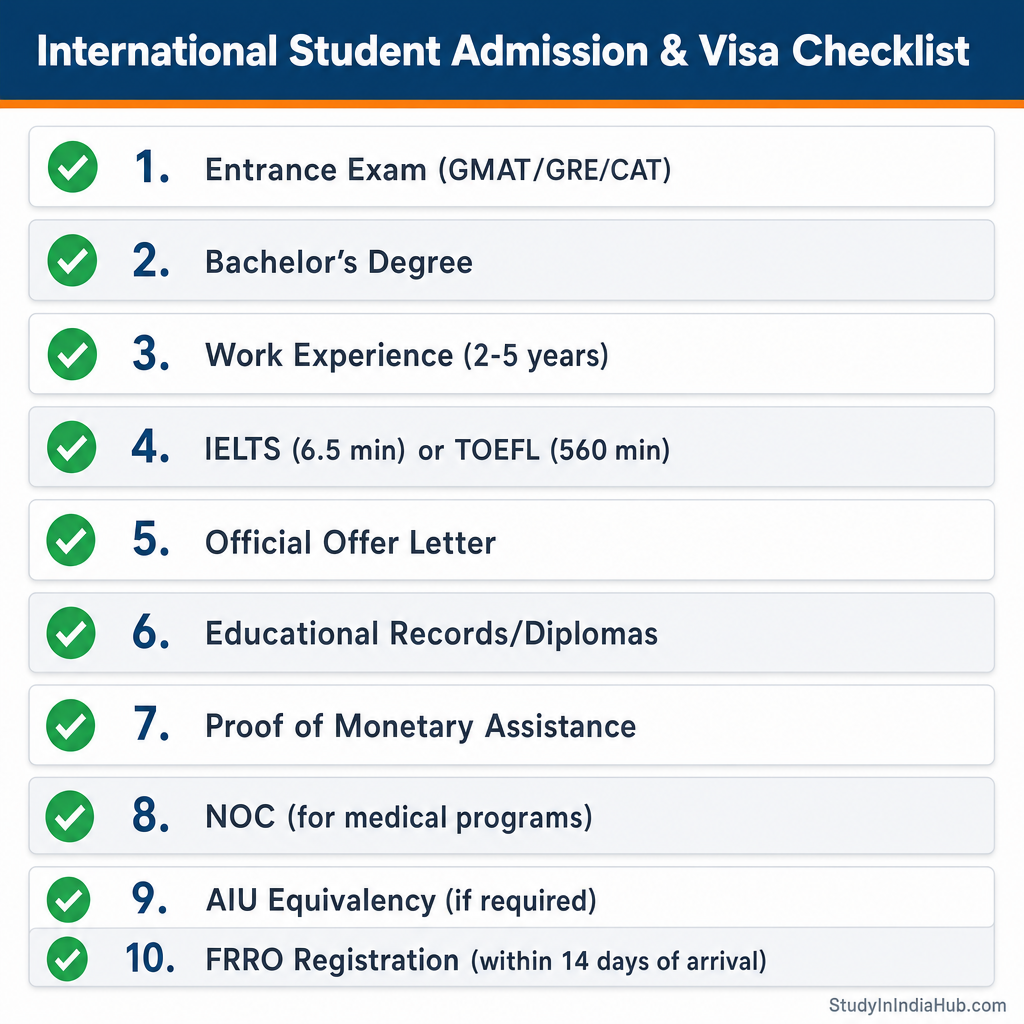
| IELTS (Academic) | 6.5 minimum | Study in India |
| TOEFL (paper-based) | 560 minimum | Study in India |
| Visa processing | Minimum 5 days | Study in India |
English proficiency scores are needed only if your prior education wasn't in English, but schedule the test before receiving the offer letter, not afterward. Delays in the visa application take weeks.Visa documentation requirements list:- Official offer letter of admission from a reputable Indian institution- Educational records and diploma certificates- Proof of monetary assistance- For medical/paramedical programs: NOC from the Ministry of Health (Study in India)Regarding credential recognition: CBSE and IB qualifications are accepted without any intermediaries. Certain boards, including various UAE secondary certificates, might necessitate an AIU equivalency certificate prior to an institution processing your application (AIU Equivalence Division). Nepali citizens can bypass the student visa process and only need a university permit (Embassy of India, Kathmandu).
Placement Stats and Salary Outcomes
| Institute | 2023 Average CTC (INR) | 2023 Average CTC (USD) | Placement Rate |
|---|---|---|---|
| IIM Calcutta | 35,07,000 | $42,750 | 100% |
| IIM Indore | 30,21,000 | $36,825 | 100% |
| Top 10 Average | 32,23,000 | $39,288 | 100% |
Take into account a typical path we've seen: a candidate hailing from Kathmandu, possessing an engineering degree and three years of experience at a medium-sized IT services company, with a GMAT score of approximately 690, gained acceptance into IIM Indore's two-year PGP along with a partial merit scholarship that covers about 40% of the tuition fees. The salary before the MBA was approximately USD 8,000 each year. After completing the MBA, the graduate secured a consulting position at a Big Four firm in India with a salary of INR 28 LPA (around USD 33,500), along with a clear opportunity to transfer to the Singapore office in 18 months. Within three years after graduation, total compensation usually exceeds USD 70,000 once regional mobility begins. This trend, South Asian candidates, partial scholarships at leading IIMs or ISB, placements in consulting or BFSI, followed by relocation to ASEAN: is commonly observed among Nepali and Sri Lankan alumni we've monitored from the 2019–2023 cohorts.
Data: GMAC
Premium salaries reach notably higher levels, with IIM Indore's highest offer in 2023 reaching INR 1.14 crore (~$140,000), representing a 132% increase from the previous year (GMAC). More generally, the leading individual packages at Indian business schools have surpassed the ₹1 crore+ threshold, with premier consulting and finance salaries usually falling within the ₹50–70 lakh CTC spectrum (IIDT Escala). Median compensation at Tier-1 institutions ranges from ₹22–32 lakh per year, offering a more accurate reference point compared to averages distorted by extremes.
Hiring Restrictions for International Students
India does not offer an automatic post-study work visa. To remain and work post-graduation, you need to change your student visa to an Employment Visa with a sponsoring employer. There are two salary limits that apply:- General roles: Annual gross salary needs to be more than USD $25,000 (~₹16.25 lakhs) (CGI San Francisco, MHA)- Faculty members at IITs, IIMs, or central universities: Minimum requirement decreases to ₹9.10 lakhs per year (India Guide)The majority of graduates from IIM Calcutta and IIM Indore exceed the general threshold with ease. The more difficult requirement is locating an employer ready to sponsor the visa, as Indian companies typically prefer to hire local citizens for domestic positions. International graduates find significant opportunities with multinationals hiring for their offices in India, including consulting firms, technology companies, and financial services firms. Companies such as McKinsey, Amazon, and Goldman Sachs hire talent from leading IIM and ISB schools for regional positions, and these are the same firms providing ₹50–70 lakh consulting and finance packages.
Recognition if You Return Home
Graduates who return to their home markets with an Indian MBA discover that the qualification holds the highest recognition throughout Southeast Asia, the Middle East, and Africa. In Western markets, degrees from IIM and ISB are highly regarded; mid-tier institutions lack distinction without significant prior experience or targeted industry ties. The Study in India (SII) Portal, initiated on August 3, 2023, has simplified the process for international employers to authenticate Indian qualifications (Ministry of Education).
ROI: India MBA vs. MBA Abroad
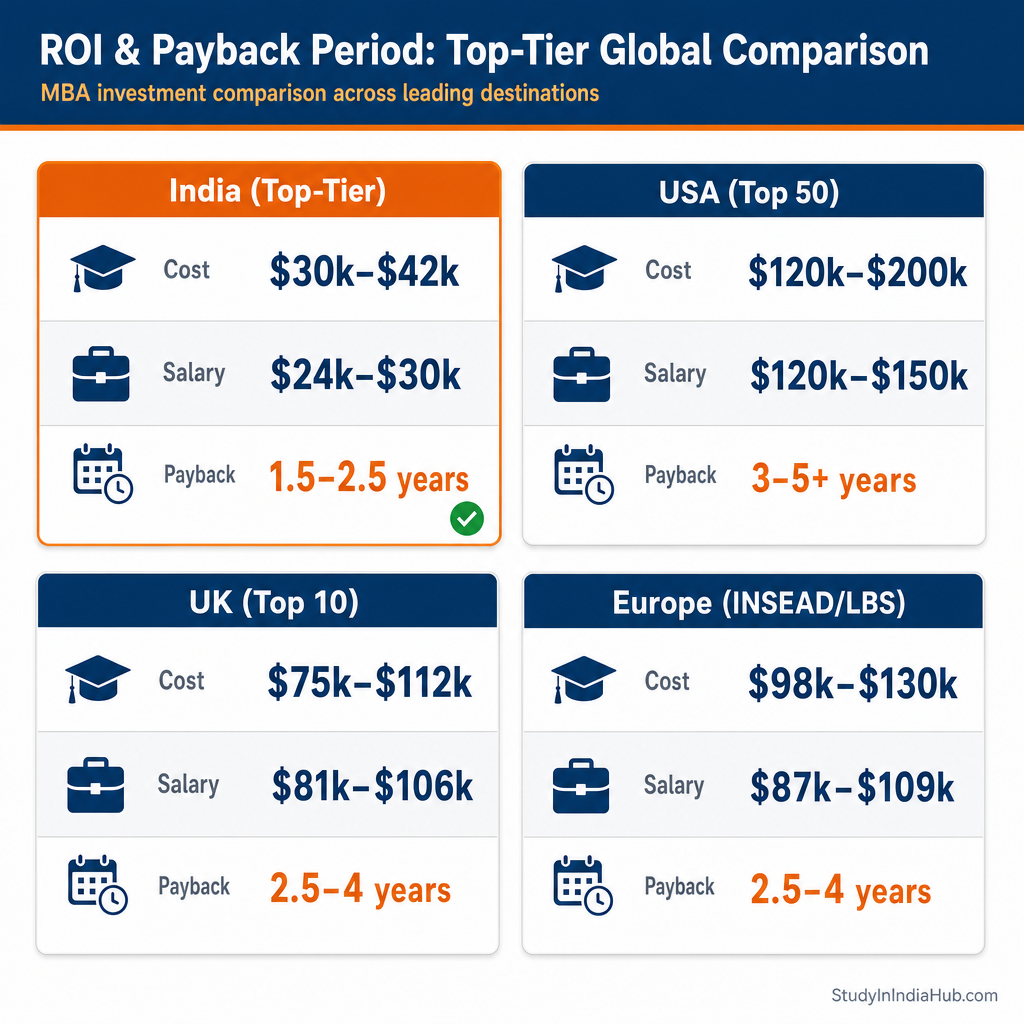
Below is a straightforward comparison of direct costs and salaries among the four primary locations. The payback period is determined by dividing the total cost of the program (tuition + living expenses) by the average annual salary after obtaining an MBA.
| Destination | Avg. Total Cost | Avg. Post-MBA Salary | Payback Period |
|---|---|---|---|
| India (Top-Tier) | ₹25–35 lakh ($30k–$42k) | ₹20–25 lakh/yr ($24k–$30k) | 1.5–2.5 years |
| USA (Top 50) | $120,000–$200,000 | $120,000–$150,000/yr | 3–5+ years |
| UK (Top 10) | £60,000–£90,000 ($75k–$112k) | £65,000–£85,000/yr ($81k–$106k) | 2.5–4 years |
| Europe (INSEAD, LBS) | €90,000–€120,000 ($98k–$130k) | €80,000–€100,000/yr ($87k–$109k) | 2.5–4 years |
India expenses rely on Symbiosis Pune's ₹24.20 lakh tuition (Nirma University) alongside ₹15,000–₹30,000/month for living (Educations.com). India salary employs an average placement CTC of ₹20,02,000. Worldwide statistics compiled from data released by schools.The payback calculations illustrate India's cost benefit clearly: a total investment of ₹30 lakh recoups in less than two years with a modest starting salary of ₹20 LPA. A $180,000 US MBA loan, despite a $150,000 salary, results in 3–5 years of repayment stress when interest and living expenses are included.The figure on the site is never the ultimate figure. In India, your total expenses vary greatly by city, with Pune and Bangalore leading the ₹30,000/month living cost range. For programs in the US and UK, include visa costs, health insurance, and rent in New York or London in addition to the already-high tuition. India also mandates evidence of INR 1,000,000 in funds during the visa process (Educations.com): a financial requirement that can delay an otherwise complete application.
Who gets the best ROI from an Indian MBA
Best ROI, applicants from South Asia, Middle East, or Africa. Students from Nepal, Bangladesh, Sri Lanka, UAE, Kuwait, and Africa are eligible for the Study in India Scholarship and ICCR funding options, potentially covering up to 90% of costs. At that expense level, the payback period declines to less than 12 months of earnings after the MBA.Strong ROI, international students lacking scholarship opportunities. Overall investment of $32,000–$42,000 with under two-year recovery still looks better than a $150,000+ US program that requires 5 years to complete.Lower ROI, students aiming for Western job markets in the long run. An Indian MBA lacks the same brand recognition in US or UK recruitment. If your location after an MBA is New York or London, the disparity in salary ceilings makes the increased debt from a local degree worthwhile.
Scholarships and Funding Options for International Students
Three funding options cater to the majority of international students: ICCR government scholarships, merit-based awards specific to institutions, and programs from their home countries.ICCR A2A Scholarships provide the most extensive government pathway, available to students from more than 100 nations. The application period for 2026–27 was from February 27 to April 15, 2026, failing to apply means a wait of one entire year (CGI Chicago). Monthly stipends amount to ₹10,000 (undergraduate), ₹12,000 (graduate), ₹14,000 (doctorate), distributed through PFMS since February 2021 (ICCR Policy Guidelines).
| Scheme | Slots | Target Students |
|---|---|---|
| ICCR Global |
Common Mistakes to Avoid
Excluding the security deposit (typically ₹25,000-₹50,000)Many international students plan for tuition and accommodation costs but overlook the refundable security deposit, required to be paid upfront with the first semester fee. Incorporate this into your initial transfer sum to avoid rushing at the last moment. The positive aspect: you will receive it again upon graduation, as long as college property is undamaged.If hostel availability is assured, submit your application soon, as places are limited.Most Indian B-schools do not automatically provide on-campus housing, even for international students. Submit your hostel application as soon as you accept your admission offer, preferably within 7-10 days. Renting off-campus near leading colleges can often be 2-3 times more expensive than staying in a hostel, making losing your reservation a costly error.Misjudging expenses for living beyond Mumbai and PuneNumerous students believe that Tier-2 cities such as Ahmedabad, Indore, or Bhubaneswar will generally be significantly less expensive, but neighborhoods near campuses frequently demand higher prices for housing, food delivery, and transportation. Allocate a minimum of ₹15,000-₹20,000 each month for living costs, even in areas outside the main metropolitan cities. Consider travel expenses as well, as smaller cities require more domestic flights for internships and networking events.Failing to submit scholarship applications prior to the deadlineScholarships for international students at Indian business schools typically have distinct, earlier deadlines compared to your admission application, often 2-3 months prior to enrollment. Review the financial aid section of each college on the same day you begin your application, and simultaneously work on your essays and recommendation letters. Institutions such as ISB, IIM Bangalore, and SPJIMR provide significant merit and need-based financial support, but the funds deplete rapidly after rounds conclude.
Frequently Asked Questions
Is it possible to use the same budget for all Indian MBAs?Not at all. MBA fees for international students at Mumbai University range from ₹42,600 to ₹840,000 annually (Shiksha/Mumbai University). At SPPU in Pune, the fee ranges from ₹50,000–₹250,000 (Shiksha/SPPU). There’s a 5x+ variation between the lowest amount at one institution and the highest at another; refer to the specific program page instead of the main site.Is it permissible for the same university to impose varying fees for different courses?Indeed. At Mumbai University, the international tuition for BTech ranges from ₹60,000 to ₹770,000, MBBS costs between ₹25,000 and ₹500,000, and MBA fees are ₹42,600 to ₹840,000 annually (Shiksha/Mumbai University, University of Mumbai). A single campus does not equate to a single price.What is the most affordable way to access Indian public universities?Delhi University's BA programs for international students commence at ₹4,800 annually (DU Foreign Students Registry). For an MBA in particular, the minimum cost is ₹50,000/year at SPPU, and this applies exclusively to government-aided seats, so check the college allocation details before budgeting for that amount (Shiksha/SPPU).What amount of buffer should I maintain in addition to tuition?Maintain 15–20% of overall yearly costs in liquid form for unforeseen travel or healthcare expenses (ImmiTalks). On a ₹300,000/year plan, that's ₹45,000–₹60,000 remaining idle. One emergency flight or private hospital trip in Mumbai can disrupt a semester if that safety net isn't available.Must I pay charges prior to receiving my visa?In India, it's common to provide evidence of funds for the first year's tuition and living expenses, making the initial payment (usually 40–60% at registration) alongside an approval letter for the balance the usual method. Certain European programs necessitate a compulsory €6,000 in advance prior to any procedures commencing (IDP). Verify the precise timetable with the accounts office prior to your visa appointment.In what ways do the living expenses in India differ from those in the UK or Canada?
| Destination | Required Living Cost Proof |
|---|---|
| UK (London) | £1,529/month (IDP) |
| UK (outside London) | £1,171/month (IDP) |
| Canada | CA$22,895/year (IDP) |
| India (Pune/Mumbai) | ~₹20,000–₹30,000/month + 15–20% buffer (ImmiTalks) |
What if the precise cost isn't listed anywhere?Obtain the most recent fee circular and the fee structure for international students directly from the admissions office. Consider any PDF on the website that lacks a date as unverified. Planning based on an old document is a frequent reason for students to be under-funded.Is it possible to work part-time to manage living expenses?Student visa regulations allow for it, but part-time jobs on campus or tutoring generally earn ₹150–₹300/hour, sufficient to cover discretionary expenses, not essential costs. Structure your financial plan around tuition and living expenses; consider part-time earnings merely as an additional safety net.
About the Author
Arun Menon dedicated three years at ICCR overseeing scholarship programs before moving to StudyInIndiaHub.com to assist international students with tuition costs, living expenses, and financial aid opportunities. He simplifies complicated fee arrangements into straightforward comparisons and is aware of which expenses universities fail to disclose initially.
How We Researched This Article
Every article is verified against original sources and assessed by educational experts who have firsthand experience in international student admissions. Our information is sourced from official university websites, naac/nirf databases, government visa portals, numbeo living cost data, and direct contacts with university international student offices. Daily updates on exchange rates. Expenses updated every week. University information evaluated every three months.
Sources
- Consulate General of India
- Study in India Portal
- ICCR
- DASA
- Chanakya University
- CollegeSearch
- MBA Exchange
- NIRF
- LeapScholar
- Numbeo
- DAAD
- Numbeo
- Statistics Canada
- Numbeo
- Study Australia
- Numbeo
- UCAS
- Numbeo
- AIU
- Embassy of India, Kathmandu
- GMAC
- IIDT Escala
- CGI San Francisco
- MHA
- India Guide
- Nirma University
- Educations.com
- Study in India Scholarship
- CGI Chicago
- Indian Embassy Kathmandu
- Jaffna Monitor
- Numbeo
- [Chanakya University](https://chanakyauniversity.edu.
If you plan to stay and work in India post-MBA → there is no automatic post-study work visa. You must convert your Student Visa to an Employment Visa with a sponsoring employer, and that employer must pay a minimum gross salary of ₹16.25 lakh per annum (~USD $25,000) - Visament - Shiksha/Mumbai University - Shiksha/SPPU - University of Mumbai - DU Foreign Students Registry - ImmiTalks - IDP